

Project Overview
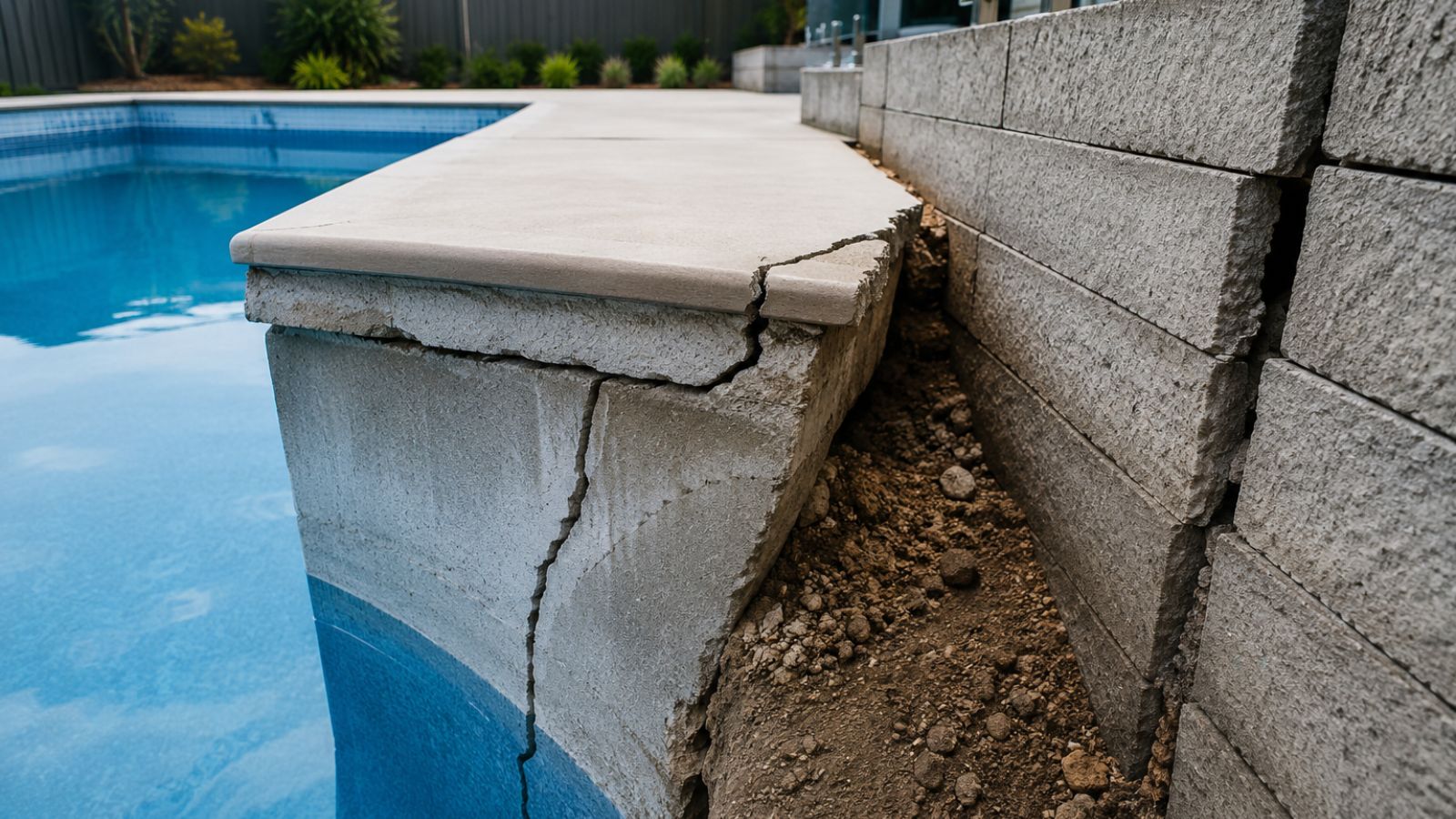
A residential construction project involved the installation of an in-ground reinforced concrete swimming pool on a sloping suburban site in South-East Queensland. Due to limited backyard space and architectural requirements, a masonry retaining wall was constructed immediately adjacent to the pool shell.
Additionally, the external concrete pool surrounds (deck slab) were poured physically bonded to the pool shell walls without an isolation joint or compressible separation material and that deck was extended to form pool coping.
Several years after completion, the owner reported:
- Cracking in the pool walls and surrounds
- Water leakage from the pool shell
- Differential movement between retaining wall and pool structure
- Tile delamination
- Expansion-related cracking in the deck slab
- Hydrostatic pressure-related distress
Subsequent engineering assessment identified multiple non-compliances with Australian Standards and poor structural detailing practices.
Existing Construction Configuration
Pool Structure
- Reinforced sprayed concrete (shotcrete) pool shell
- Reinforced bond beam around perimeter
- Concrete pool surrounds cast directly against shell top wall beam
- No articulated joint between shell and deck
Retaining Wall
- Reinforced concrete masonry retaining wall
- Located within 150–300 mm of pool shell externally
- Wall footing founded independently
- No engineered movement allowance between wall and pool
- Limited subsoil drainage provisions
Relevant Standards
- AS 2783 “Use of reinforced concrete for small swimming pools“
- AS 2870 “Residential slabs and footings”
- AS 3600 “Concrete structures”
- AS 3735 “Concrete structures for retaining liquids”
- AS 4678 “Earth-retaining structures”
- AS 3700 “Masonry Structures”
- NCC (National Construction Code)
Key Non-Compliances With Australian Standards
1. No Isolation Joint Between Pool Shell and Surrounds
Non-Compliance
The pool surrounds were rigidly connected to the pool shell bond beam, creating a monolithic slab arrangement with no allowance for Thermal expansion/contraction, Differential settlement, Shrinkage movement, Reactive soil movement, and Structural independence
Industry Best Practice
Concrete pool surrounds should generally be isolated from the pool shell using:
- Compressible foam joint
- Expansion joint material
- Flexible sealant
2. Retaining Wall Constructed Too Close to Pool Structure
Non-Compliance
The retaining wall surcharge zone overlapped with the pool shell influence zone.
Risks included Lateral soil pressure transfer onto pool shell, Differential settlement, Hydrostatic loading concentration, and Footing interaction
Retaining walls adjacent to pools require engineering analysis to ensure:
- Pool shell is not acting as unintended retaining structure
- Footings do not undermine each other
- Excavation zones remain stable
- Both Structures are not in the area of influence of each other
3. Inadequate Drainage Behind Retaining Wall
Non-Compliance
The retaining wall lacked Adequate agricultural drainage, Free-draining backfill, Geofabric separation, and Pressure relief outlets
Result:
- Build-up of hydrostatic pressure
- Saturated soils adjacent to pool shell
- Increased structural loading
4. Lack of Articulation and Movement Control
Non-Compliance
Large expanses of surrounding concrete lacked Control joints, Articulation joints, and Isolation interfaces.
This caused random shrinkage cracking and stress transfer into the pool shell.
Structural Risks Identified
1. Differential Movement
The retaining wall footing and pool shell footing behaved independently due to Different founding depths, Different stiffness, and Variable moisture conditions
Result:
- Relative movement between structures
- Cracking at rigid connection points
2. Stress Transfer into Pool Shell
Because the deck slab was bonded directly to the shell:
- Expansion and shrinkage stresses transferred into pool beam
- Pool shell experienced unintended restraint loading
- Tensile cracking developed near coping line
3. Hydrostatic Pressure Accumulation
Poor retaining wall drainage caused Saturated soil conditions, Increased lateral pressure, and Water migration toward shell
Consequences:
- Waterproofing failure
- Structural cracking
- Long-term durability reduction
4. Reactive Soil Effects
On reactive clay sites, rigidly connected external slabs commonly induce:
- Heave-related stresses
- Seasonal movement cracking
- Coping displacement
Failure Symptoms Observed
Structural Symptoms
- Vertical cracking in retaining wall
- Pool beam cracking
- Coping separation
- Deck slab cracking
- Tile fractures
Waterproofing Symptoms
- Persistent water loss
- Efflorescence
- Damp soil zones
- Calcium leaching
Serviceability Symptoms
- Uneven paving
- Trip hazards
- Joint opening
- Surface ponding
Engineering Investigation
The investigation included:
- CCTV drainage inspection
- Ground-penetrating radar
- Concrete crack mapping
- Dilapidation survey
- Soil classification
- Structural assessment
Findings concluded:
- Structural interaction between retaining wall and pool shell was unintended and poorly detailed.
- Pool surrounds should not have been rigidly tied into the shell.
- Drainage failure significantly increased retaining pressures.
- Long-term movement was foreseeable and preventable.
Structural Remediation Solutions
Solution 1 — Saw-Cut Isolation Joint
This Allows:
- Independent movement
- Thermal expansion
- Reduction of restraint stresses
Solution 2 — Retaining Wall Underpinning and Drainage Upgrade
This Reduces:
- Hydrostatic pressure
- Soil saturation
- Lateral loading
Recommended Best-Practice Design Approach
Pool Shell
- Structurally independent
- Designed for earth and hydrostatic loads
- Waterproofed externally where required
Retaining Wall
- Separate structural system
- Independently engineered
- Drained properly
- Outside pool influence zone
Pool Surrounds
Should include:
- Isolation joint at shell interface
- Articulation joints at regular spacing
- Flexible sealant joints
Lessons Learned
Key Technical Lessons
1. Pools Are Precision Hydraulic Structures
Swimming pools are not conventional slabs:
- Even small cracks can cause leakage
- Movement tolerances are very low
2. Adjacent Structures Must Be Isolated
Retaining walls, decks, and pool shells should generally move independently unless specifically engineered otherwise.
3. Drainage Is Critical
Poor drainage behind retaining walls dramatically increases structural risk adjacent to pools.
4. Concrete Shrinkage and Thermal Movement Must Be Accommodated
Rigid connections between external slabs and pool shells commonly lead to restraint cracking.
Conclusion
This case study demonstrates how poor structural detailing between a retaining wall, pool shell, and surrounding concrete can create significant long-term structural and waterproofing failures.
The primary failures arose from:
- Lack of isolation joints
- Retaining wall proximity
- Inadequate drainage
- Failure to accommodate differential movement
Compliance with the Australin Standards combined with proper structural articulation and drainage detailing would likely have prevented the observed failures.
The remediation works successfully reduced ongoing movement and restored structural serviceability; however, rectification costs significantly exceeded the original cost of proper compliant construction detailing.