

1. Background
A 30-year-old reinforced masonry Holiday Apartments building exhibited signs of structural deterioration within the basement level. The structure consists of core-filled concrete masonry block (CMU) walls forming retaining and load-bearing walls for the entire building.
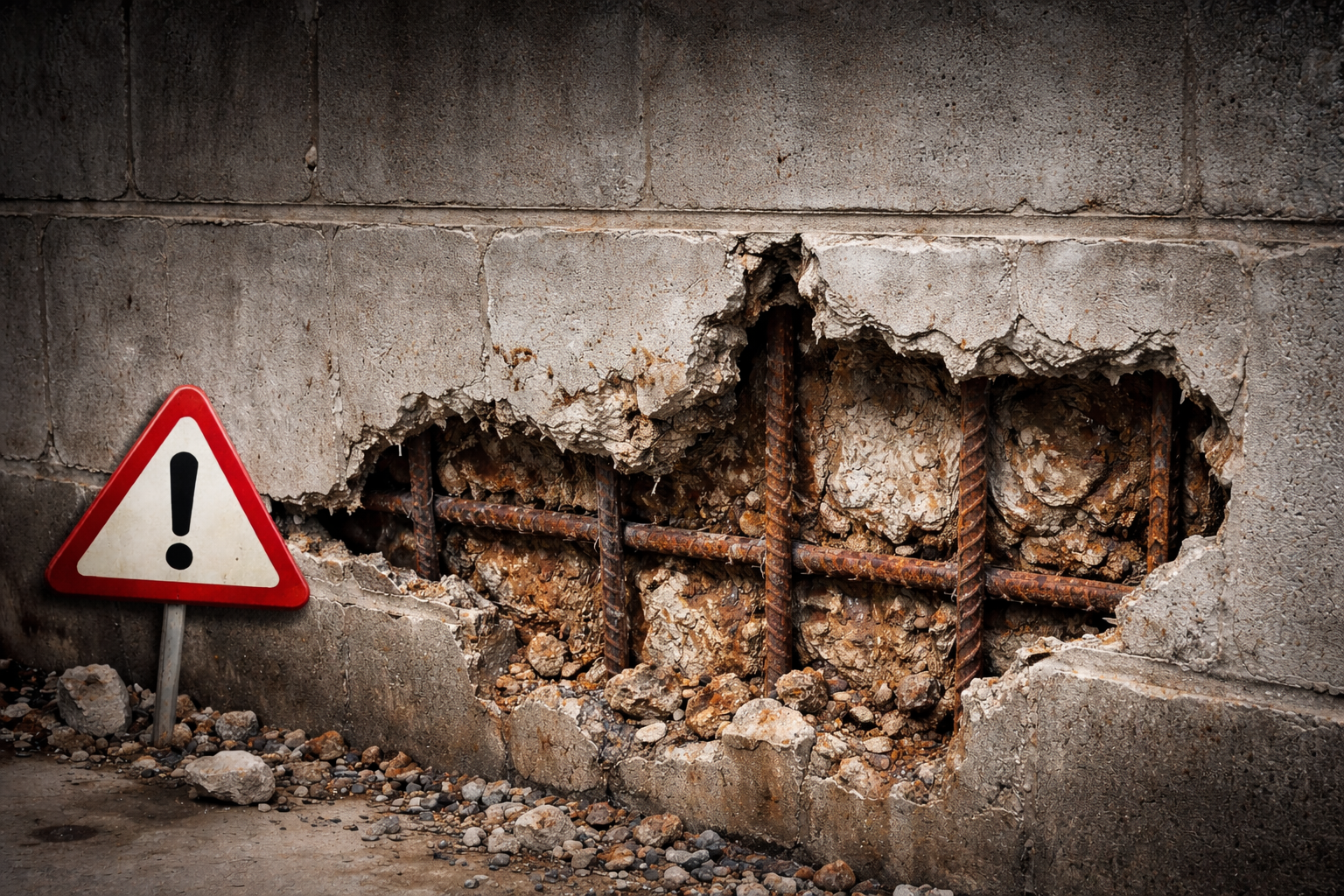
During a routine condition assessment, cracking in various direction, rust staining, efflorescence marks, and localized spalling were observed along several basement wall sections, prompting a detailed investigation into potential reinforcement corrosion and the structural integrity of the basement walls.
2. Observed Defects
The following defects were documented:
- Longitudinal cracking aligned with reinforcement locations
- Diagonal and stepping cracking
- Delamination and spalling of some blocks
- Rust staining and efflorescence
- Damp patches and active water ingress through construction joints
- Hollow sounding masonry when hammer tapped
- Reduced cover thickness in some areas
Damage was most severe along:
- External retaining walls exposed to soil moisture
- Failed waterproofing membranes behind the wall
- Locations with poor drainage or hydrostatic pressure
3. Investigation and Testing
3.1 Visual & Structural Inspection
A detailed survey mapped deterioration zones and assessed structural significance.
3.2 Non-Destructive Testing
- Corrosion testing indicated a high probability of reinforcement corrosion.
- Cover meter scanning showed inconsistent reinforcement cover.
- Moisture readings confirmed persistent dampness.
3.3 Material Sampling
Core samples and laboratory analysis revealed:
- Carbonation depth reaching reinforcement level in several zones
- Elevated chloride levels near retaining walls
- Reduced concrete strength in deteriorated cores
- Active corrosion of steel reinforcement
4. Root Cause Analysis
Concrete cancer resulted from a combination of durability failures:
- Water ingress through failed waterproofing and poor drainage.
- Carbonation reducing concrete alkalinity and allowing steel corrosion.
- Chloride contamination from surrounding soils or groundwater.
- Insufficient cover to reinforcement in original construction.
These mechanisms caused reinforcement expansion, cracking, and progressive masonry spalling.
5. Structural Risk Assessment
Engineering assessment concluded:
- Localised structural weakening of several wall sections
- Potential reduction in load-bearing capacity due to the extent of corrosion
- Increased risk of moisture damage to adjacent basement spaces
6. Rectification Recommendations
6.1 Wall Strengthening and Rebuilding
Scope:
- Partial demolition of severely affected walls
- Reconstruction with new reinforced core-filled masonry
- Installation of modern waterproofing membrane and drainage system
Advantages:
- Long-term structural solution
- Addresses root moisture causes
- Risk reduction of further deterioration of this critical structural elements which is bearing considerable building loads
Limitations:
- High cost
- Significant construction disruption
6.2 External Waterproofing & Drainage Upgrade
Scope:
- Excavate perimeter or investigate feasibility of injection method
- Install new waterproof membrane
- Provide subsoil drainage and relief outlets
Advantages:
- Treats primary cause (water ingress)
- Essential for durability of any repair
Limitations:
- Excavation access required
- Moderate to high cost
7. Recommended Strategy
A combined remediation approach was recommended:
- External waterproofing and drainage upgrade to eliminate moisture source.
- Localised demolition and rebuilding of severely deteriorated wall sections.
- Patch repair and corrosion protection in low to moderately affected areas.
- Application of protective internal coating system.
- Ongoing structural monitoring program.
This approach balances cost, durability, and structural safety while extending service life by an estimated 25–40 years.
8. Lessons Learned
- Basement retaining walls are high-risk for moisture-driven corrosion.
- Waterproofing failure is the dominant trigger for concrete cancer.
- Early detection allows low-cost repair instead of reconstruction.
- Long-term durability requires integrated structural and waterproofing solutions.